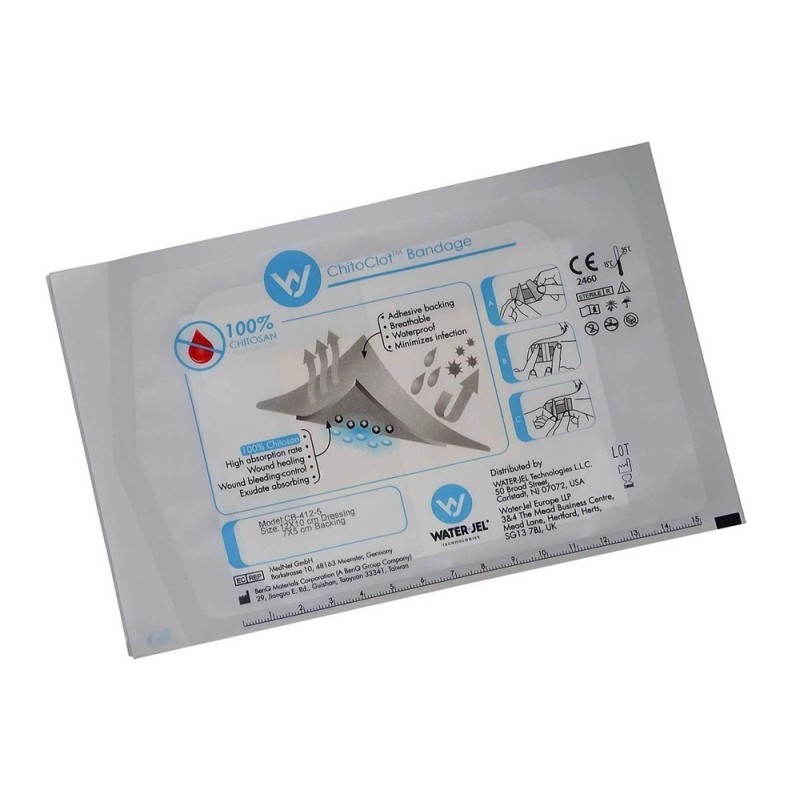

The Water-Jel ChitoClot bandage is a chitosan-based haemostatic dressing that accelerates natural clot formation on contact with blood. Designed for moderate to severe bleeding where direct pressure alone is insufficient to control haemorrhage. The chitosan fibres activate on contact with blood, promoting rapid clot formation at the wound site.
Compliance Summary: This dressing uses chitosan haemostatic technology for accelerated clot formation. Haemostatic dressings are classified as medical devices and are manufactured to applicable UK and European medical device regulations. Training in haemostatic dressing application is recommended before use.
How does chitosan stop bleeding?
Chitosan is a naturally derived polysaccharide that activates on contact with blood. The chitosan fibres attract red blood cells and platelets to the wound surface, accelerating the natural clotting cascade and forming a stable clot faster than direct pressure alone. This mechanism works independently of the body's normal clotting factors.
Can I use this without training?
Haemostatic dressings are most effective when applied correctly by trained personnel. Incorrect application - such as insufficient wound packing or inadequate pressure - reduces effectiveness. Training in haemostatic dressing application is strongly recommended and is typically included in catastrophic bleeding response courses.